Home › Services › Real estate › T-12 from bank statements
A T-12 from your bank statements, checked line by line
No T-12 from the seller, or one you don’t trust? Send twelve months of the property’s bank statements. You get back a cash-basis T-12 in Excel, month by month, with every bank transaction placed on its line and net operating income worked out.
Coming soon
What people use it for
- When the seller has no T-12. Small owners often keep no books, only a bank account. Their statements become the year’s operating statement.
- Checking the seller’s T-12. Set the T-12 the bank statements show next to the one you were sent, and see where they part.
- Lender and partner files. A trailing twelve months with every figure traceable to a bank transaction.
- Your own properties. A clean year of income and expenses, line by line, from the account you already have.
What you send
- Twelve months of bank statements for the property’s operating account, as the bank sends them.
- The check register, if checks are paid from the account. A statement shows only a check’s number; the register says who it paid.
- A rent roll, if you have one, ideally one for each month-end. With it, the T-12’s income can show potential rent, loss to lease and vacancy.
- The property type and name, on the order form: apartments, office, retail, industrial, flex, a hotel, a healthcare facility, parking, self storage or land.
What’s in the workbook
It opens on a cover that lists every tab. Click a tab’s name to go to it.
| Tab | What it shows |
|---|---|
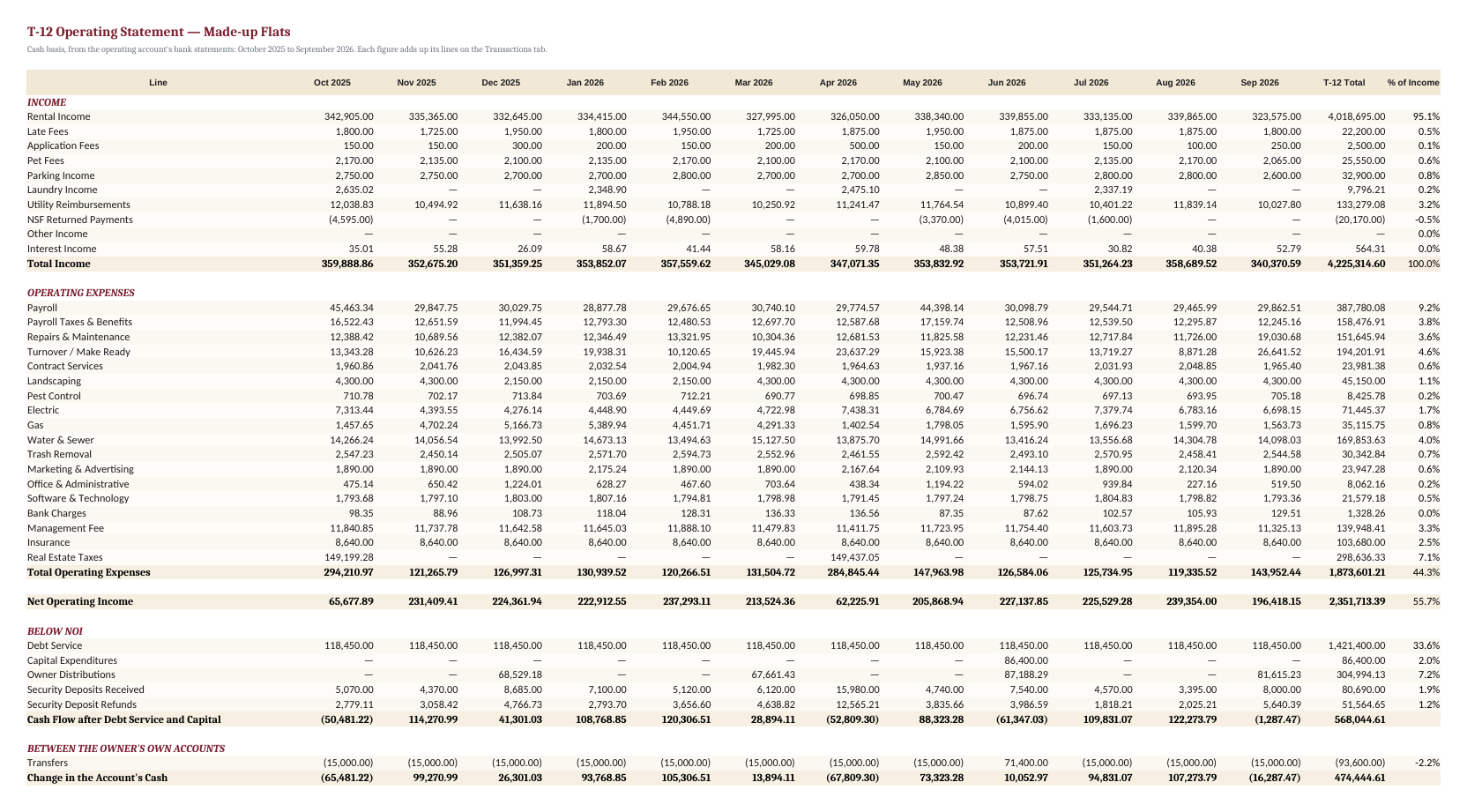
| T-12 | The twelve months side by side and a total: income, operating expenses and NOI, then debt service, capital work, one-time items and the owner’s money below NOI. |
| Transactions | Every line of every statement, in date order, with the T-12 line it’s on. |
| Statements | Each statement’s period, beginning balance, deposits, withdrawals and ending balance. |
| Notes | How the T-12 was built, and what a cash-basis T-12 does and doesn’t show. |
Every figure on the T-12 is an Excel formula that adds up its transactions, so you can trace any month of any line to the bank lines in it.
The lines follow the property type. An apartment T-12 has rents, late fees, pet fees, parking, laundry and utility reimbursements; an office, retail, industrial or flex T-12 has base rent, expense recoveries and the building’s own costs, such as janitorial, elevator and HVAC. A hotel’s has room, food and beverage revenue and its departments’ costs; a healthcare facility’s has private pay, Medicare and Medicaid; a parking facility’s has daily and monthly parking; self storage has rent, fees and tenant protection; land has ground, farm and billboard rent.
See a sample
Made with a made-up apartment community, so every name and figure is invented.
One-time items stay out of NOI
A T-12 is read as a normal year, so anything that won’t happen again is kept below NOI on its own line: a renovation or a roof, an insurance claim paid, a lawsuit settled, a lease buyout, a tax refund, storm damage, the costs of buying or refinancing the property. Capital work goes on Capital Expenditures.
Some one-time payments don’t say what they are. A payee who shows up in only one or two months of the year, for a sum that matters to the property, is asked about, whatever its words. Your answer puts it on its line.
How we check every T-12
Every T-12 goes through up to 28 accuracy checks before it reaches you. Among them:
- Every statement’s transactions add up to the ending balance the bank printed, to the cent, and the statements run in an unbroken chain with no month missing.
- Every bank transaction is on the T-12 exactly once, and every one is on a line.
- Money that isn’t operating income or expense, such as transfers between the owner’s accounts, the loan, security deposits and the owner’s own money, is never counted in NOI.
- Every transaction’s line is checked against its own words, so a utility bill can’t sit under rent or a repair under capital work.
- The finished workbook is calculated again and each total compared with the transactions, and nothing in it is cut off or hidden.
Questions
What do I need to send?
Twelve months of bank statements for the property’s operating account, as the bank sends them. If checks are paid from the account, send the check register too, so each check is put on the right line. If you have a rent roll, send it as well, ideally one for each month-end. Tell us the property type and name on the order form.
Which property types can I send?
Apartments, office, retail, industrial, flex, hotels, healthcare, parking, self storage and land.
Is it cash basis or accrual?
Cash basis from the bank statements alone: the T-12 shows the money that came in and went out each month. Send a rent roll too and you can choose a T-12 whose income shows potential rent, loss to lease and vacancy, down to the rent collected, with expenses on a cash basis.
What happens to one-time items like a renovation or an insurance claim?
They’re kept below NOI on their own lines, so NOI shows a normal year. Capital work goes on Capital Expenditures. If a payment only shows up once or twice in the year and we can’t tell from its words whether it’s one-time, we ask you.
Will you ask me questions?
Only when the statements can’t answer something, such as a payee we can’t place or a payment that might be one-time. We ask in plain words.
Is it an appraisal or an audit?
No. It’s a T-12 built from your bank statements, for you to underwrite or report with. It isn’t an appraisal, an audit or investment advice.
Coming soon
Want to hear when it opens? Write to info@binadesk.com. In the meantime, our bank statement and document extraction services are open and free during the beta.