Fit
Send us the files. We run them — and then every number has to prove itself against your own paperwork before it reaches you. Your documents are the answer key. Not our confidence, not the model’s.
Flat-rate quote within hours · Most projects delivered same day · If an error traceable to us reaches you, we fix it free.
A caterer had three years of supplier invoices in filing cabinets — around a thousand pages. He wanted to know what he was spending and with whom, so he uploaded them to a consumer AI tool.
What came back read beautifully. Then he checked it against the paper. Line items that weren’t on any invoice. Totals that didn’t match their own invoice. Credits counted as purchases. He couldn’t tell which parts were right without redoing all of it — so a report that took minutes to produce was worth nothing to him.
AI doesn’t fail the way a tired bookkeeper fails. It makes plausible mistakes — right vendor, right price range, right format, simply not on the invoice. That is why reading it over doesn’t catch it, and why nine right answers make you trust the tenth.
Six AI systems were each given a contractor’s job data and their accounting policy, and asked to build the work-in-progress schedule — the document that goes to the bank and the bonding company.
Two got it right. One invented the data outright. The other three were wrong by six figures.
The wrong ones were formatted correctly, cited the right policy clauses, and showed their working. Nothing on the page distinguished them from the two that were right.
We don’t ask you to trust that we picked the right system. Every figure traces to the source it came from and the clause that governs it, every total is recomputed independently, and you get the log showing what was checked.
From a single spreadsheet to a thousand-page batch — flat-rate quote within hours, no commitment until you approve the number.
Asking a machine to grade its own homework is how a wrong number gets a confident sign-off. So we don’t. Every figure has to survive a set of checks that don’t care how sure anything is — they care only what your paperwork actually says.
This is what lets us take on work we’ve never seen before. The structural layer is fixed and runs on everything. The layer above it is written for your deliverable, from the policy, contract or standard that governs it.
These know nothing about your business. They catch the ways any deliverable can be broken.
This is the layer that catches what actually goes wrong, and it can only be written once we know what governs your deliverable.
Where you have a written policy, we work to it and cite the clause behind every judgment. Where you don’t, we apply the standard treatment and hand you a list of every decision we made.
In plain English. Each one either passes, or it stops the file.
Scanned pages are read through twice, with different settings, and the two readings are compared character by character. Where they disagree, a person opens the image and reads it themselves.
Catches: a smudged 3 read as an 8.
Before any figure goes into your file, we go back to the document it claims to come from and confirm it is actually printed there. If it isn’t, it does not ship — no matter how sensible it looks.
Catches: an invented line item.
Your documents already contain their own answer key. An invoice prints its own total — so our line items, plus tax, plus freight, must add up to that printed total. A bank statement prints its own ending balance — so the opening balance plus every deposit minus every withdrawal must land on it exactly. If we misread anything, these stop matching.
Catches: any misread number, anywhere in the batch.
Your finished workbook is opened cold by a separate spreadsheet program and every formula recalculated from nothing. A formula quietly pointing one row off gives a different answer the second time — and the two have to agree.
Catches: a total that silently skips a row.
This is the one nobody thinks about. A check pointed at the wrong column examines nothing, finds nothing wrong, and reports a clean pass — the most dangerous result there is. So every check must report how many rows it looked at, and a check that examined too few fails the file rather than passing it.
Catches: a green light that means nothing.
Independent models — never the same one that did the work, because nothing marks its own paper here — are handed the finished file and your original documents and told to assume an error exists and go find it. They report defects with exact locations, or state plainly that none were found and what they checked.
Catches: what a single system was blind to.
Before delivery the file is stripped and inspected: no leftover sample rows from our templates, no hidden tabs, no stray comments, no names in the document properties. Every cell in what you receive traces back to your job.
Catches: someone else’s data in your file.
The verified workbook is fingerprinted, and the fingerprint is checked again at the moment of delivery. What lands in your inbox is byte-for-byte the file that cleared every check above — not a later copy, not a re-export.
Catches: the wrong version being sent.
Software doesn’t get tired, but it also doesn’t understand what you asked for. An analyst works every row the checks above stopped — reading the original page and resolving it — plus a random sample of the rows that passed, and confirms the deliverable answers the question you actually asked.
Catches: a correct answer to the wrong question.
None of this is a promise about how careful we are. Every one of them either passes or stops the file — and you get the log showing which.
Once the file has passed every check, it goes to three separate AI systems — none of them the one that produced the work, because a system reviewing its own output is not a review. Each is handed the finished file and your original documents and told to assume an error exists and go find it.
They report defects with exact locations, or they state plainly what they examined and found nothing. Where two of them disagree about the same figure, that figure goes to a person regardless of what the automated checks said.
This is the layer that catches what a rule was never written for — the assumption nobody thought to question, the line that reconciles perfectly and still looks wrong to a reader who knows the work.
An analyst works every row the checks stopped — opening the original page and resolving it — plus a random sample of the rows that passed, and confirms the deliverable answers the question you actually asked rather than a nearby one.
Where something genuinely cannot be settled from the documents we were given, it reaches you marked, with the source page beside it and the reason stated. We don’t guess, and we don’t deliver a guess unlabelled.
These checks prove your numbers agree with your documents and that the arithmetic holds. They do not tell you whether an assumption suits your lender, whether a project manager’s estimate is realistic, or whether claimed progress matches the work actually standing on site. Those are judgments, and they stay with you and your advisors.
We would rather say that plainly than imply a coverage we don’t have. A verification service that overstates its own reach has nothing left to sell.
Flat-rate quote within hours. Nothing owed until you approve the number.
Watermarked previews of the actual deliverable format — illustrative data, not a live or editable file. Click any image to enlarge it, then click again to zoom in for a closer look.
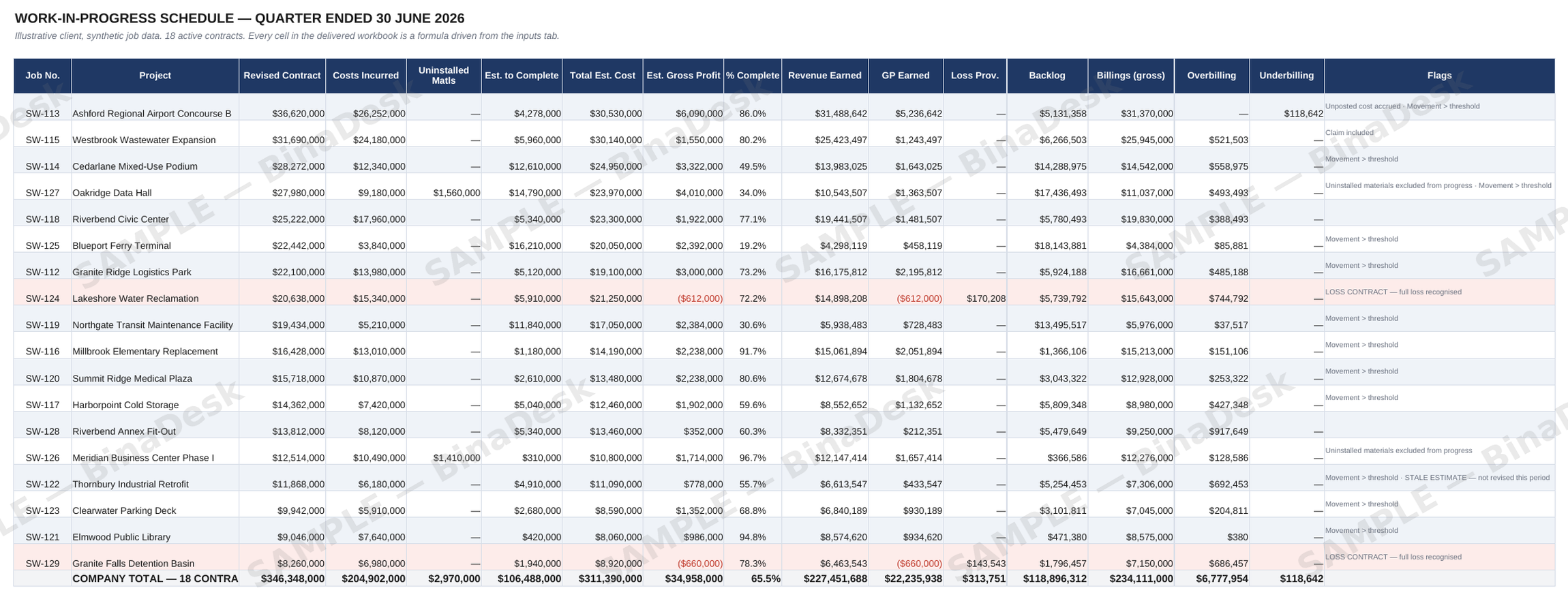
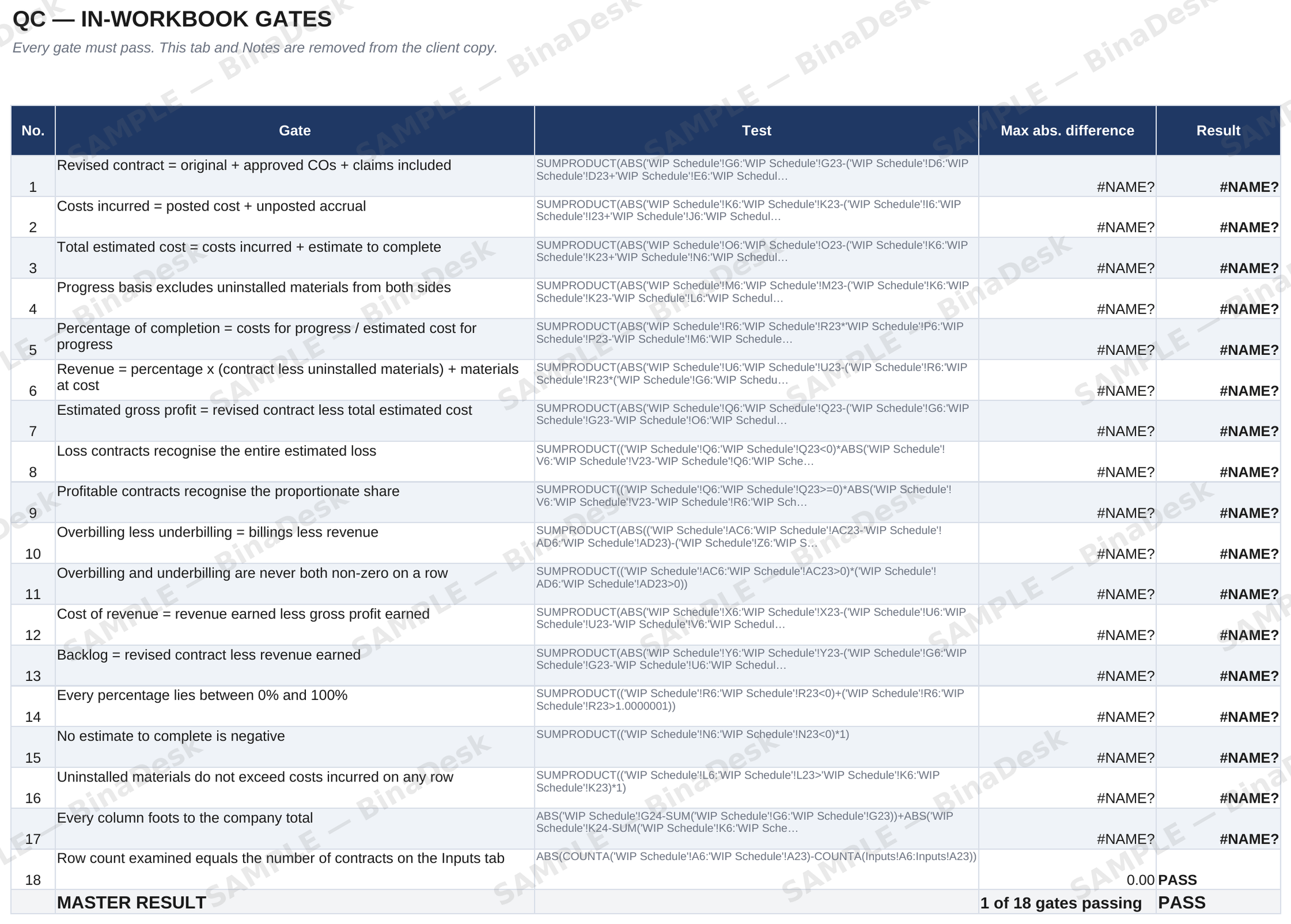
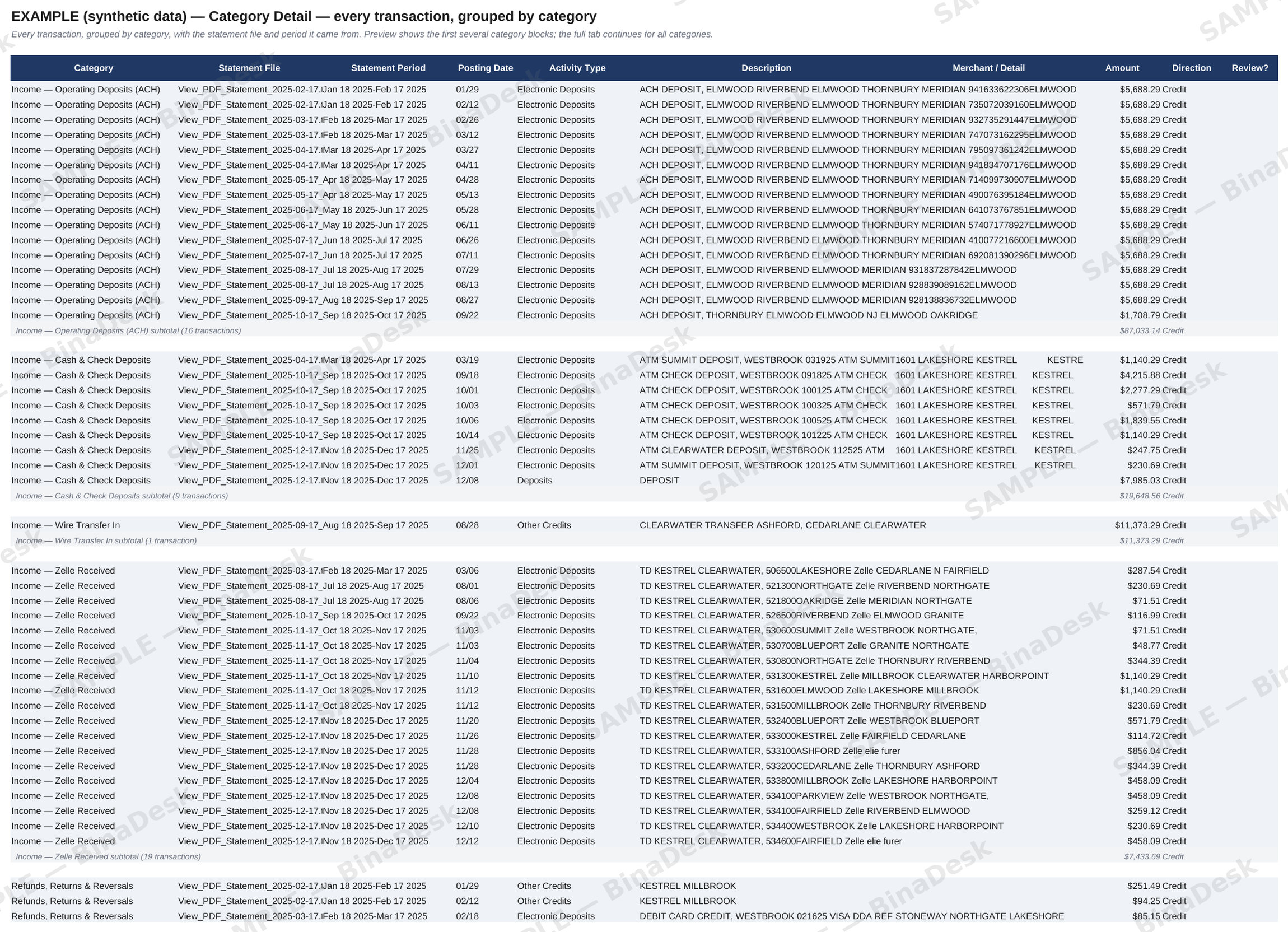
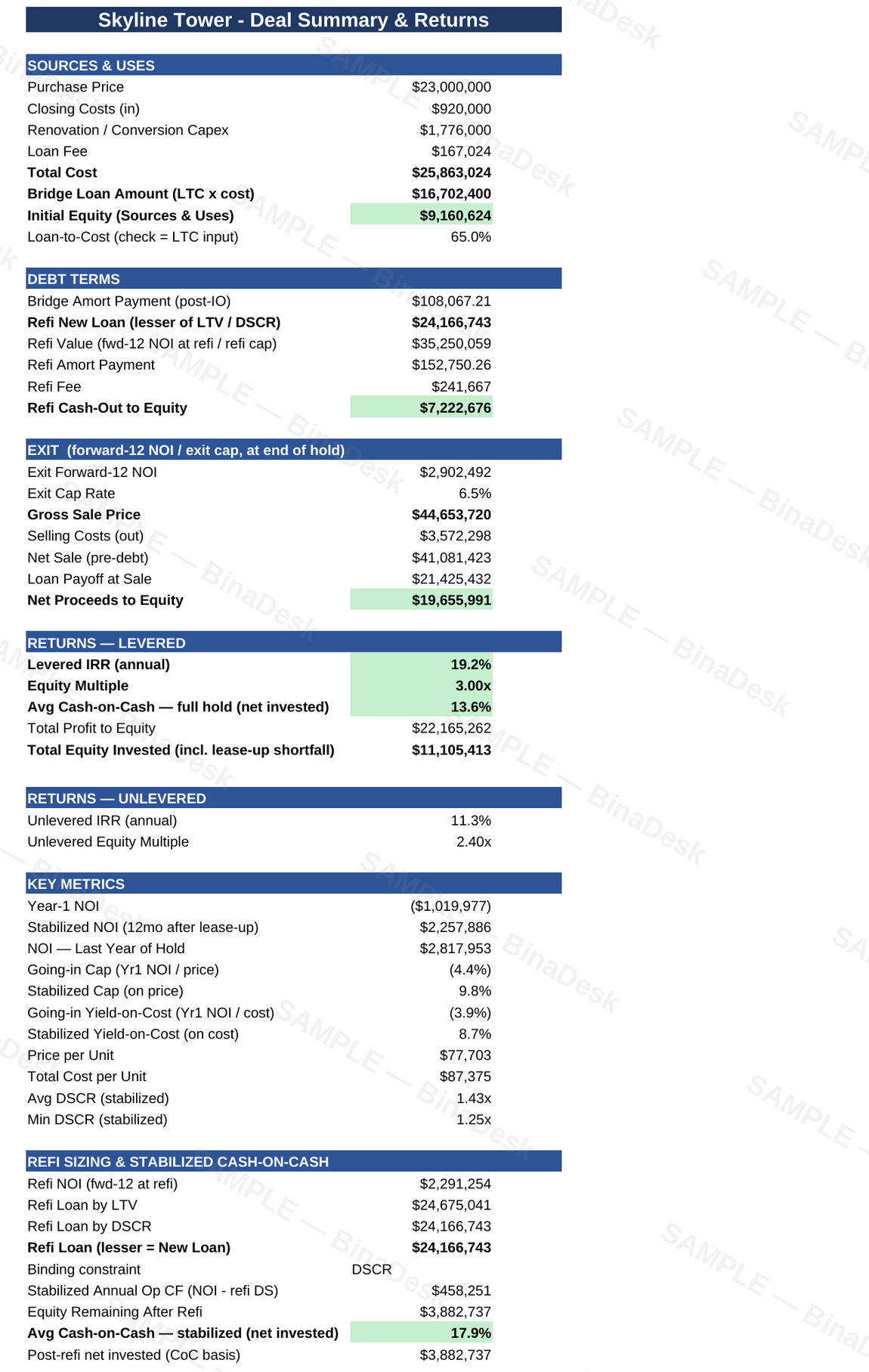
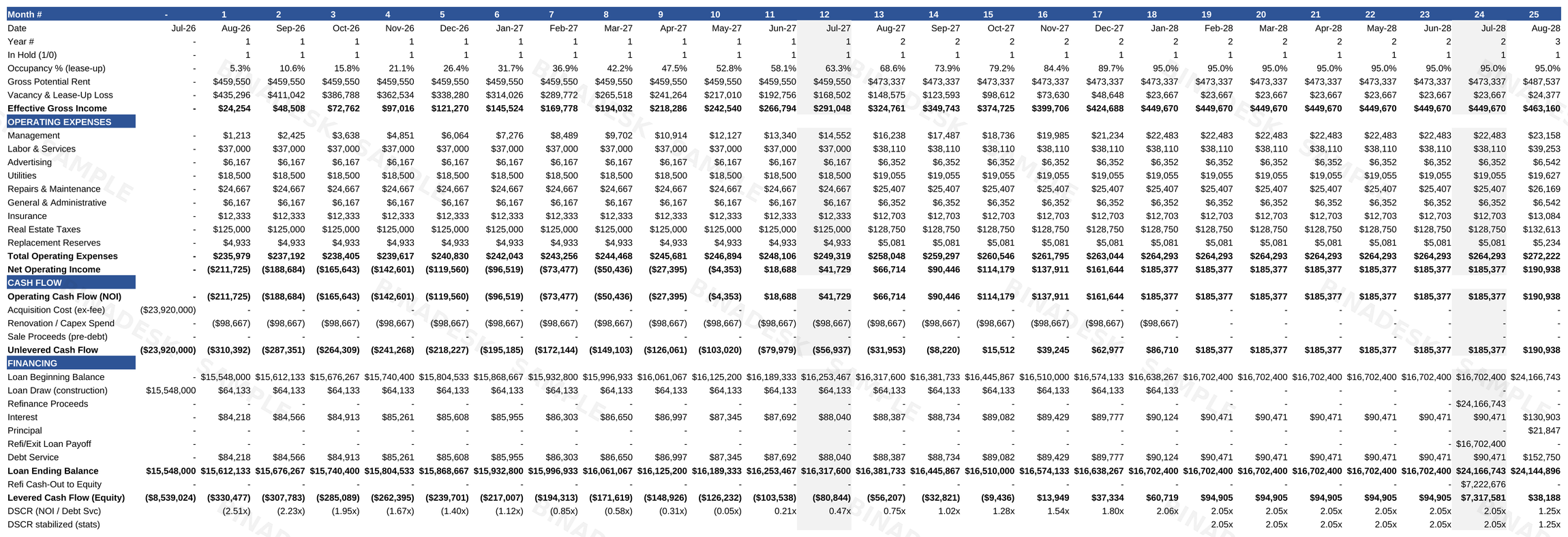
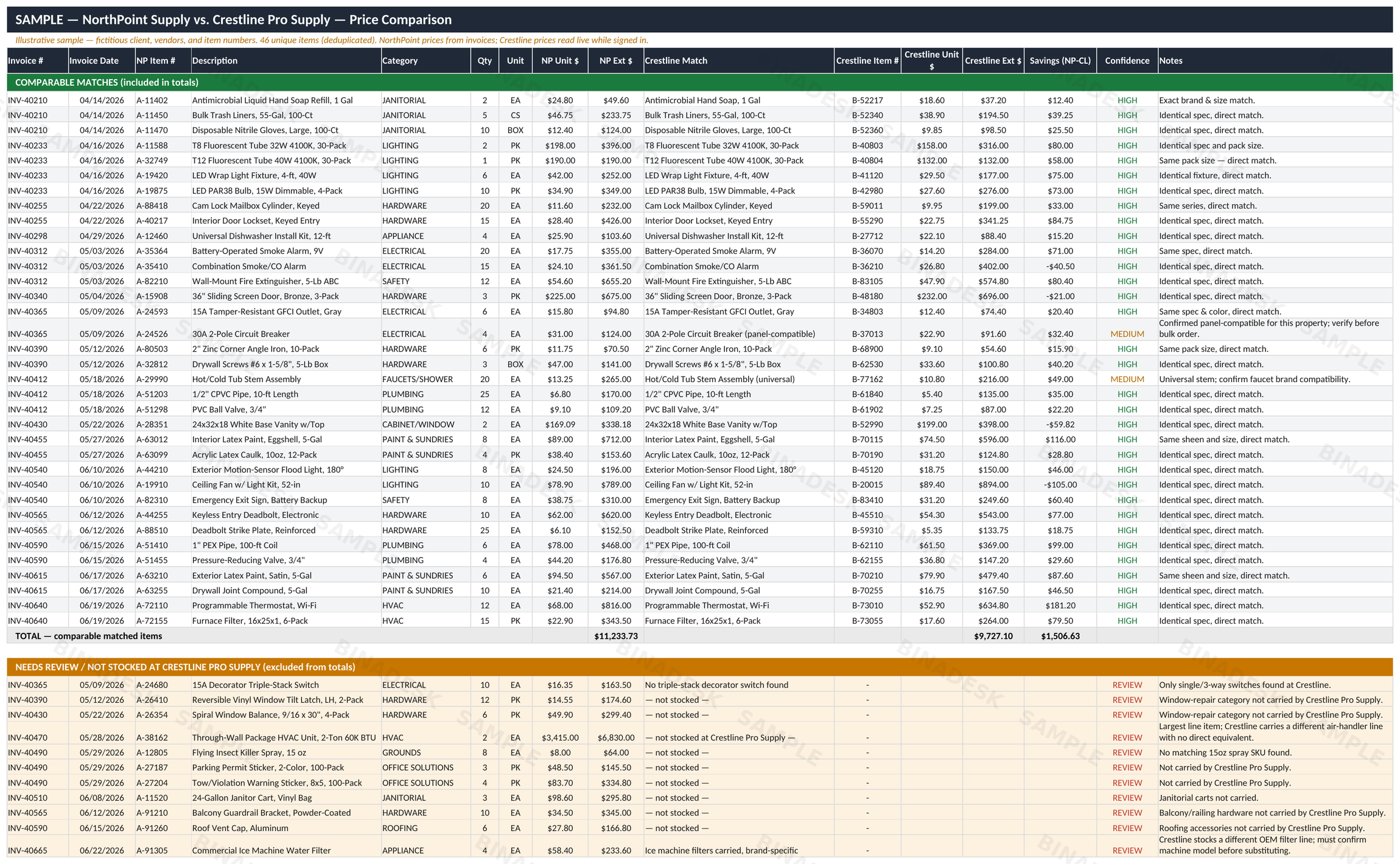
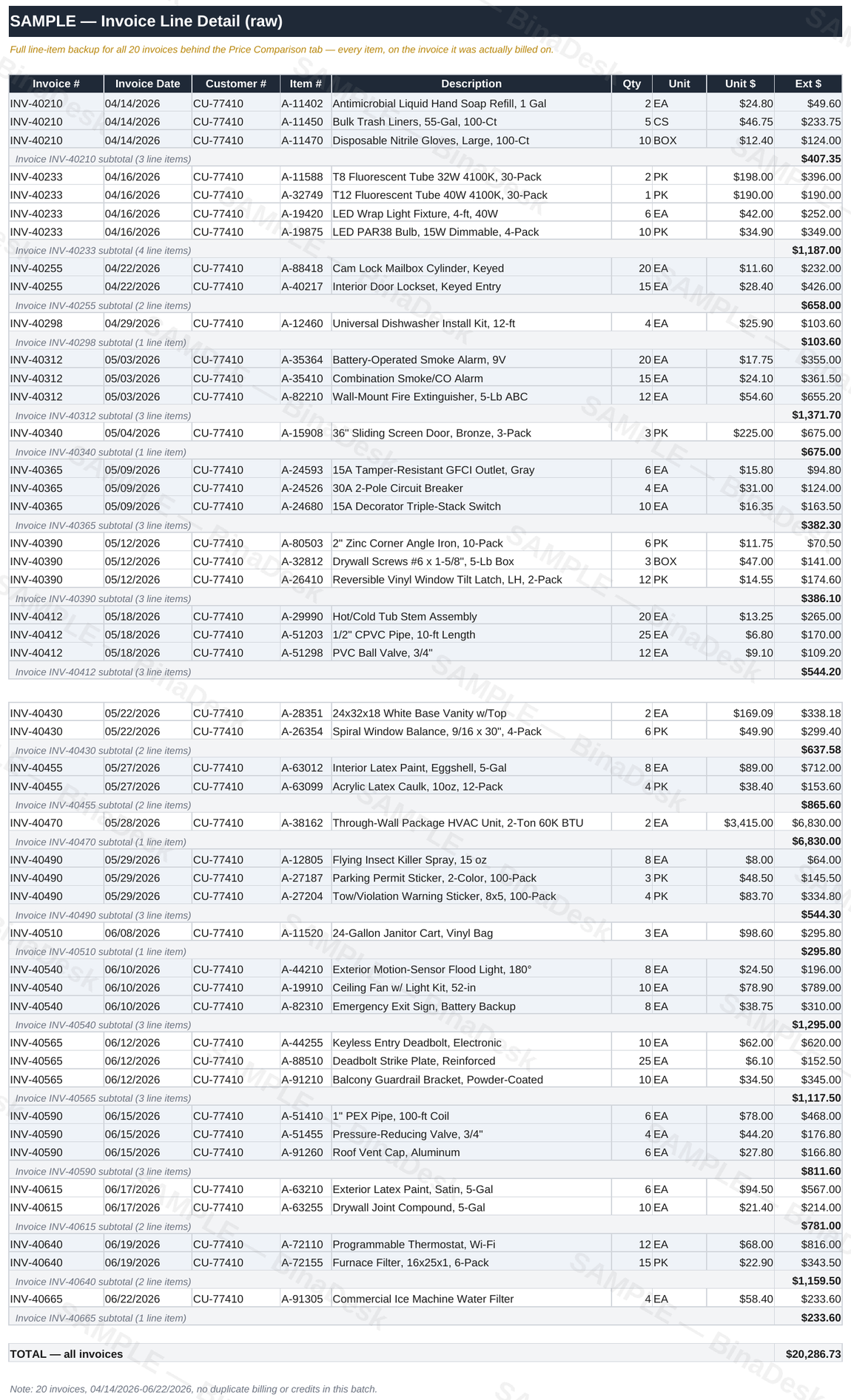
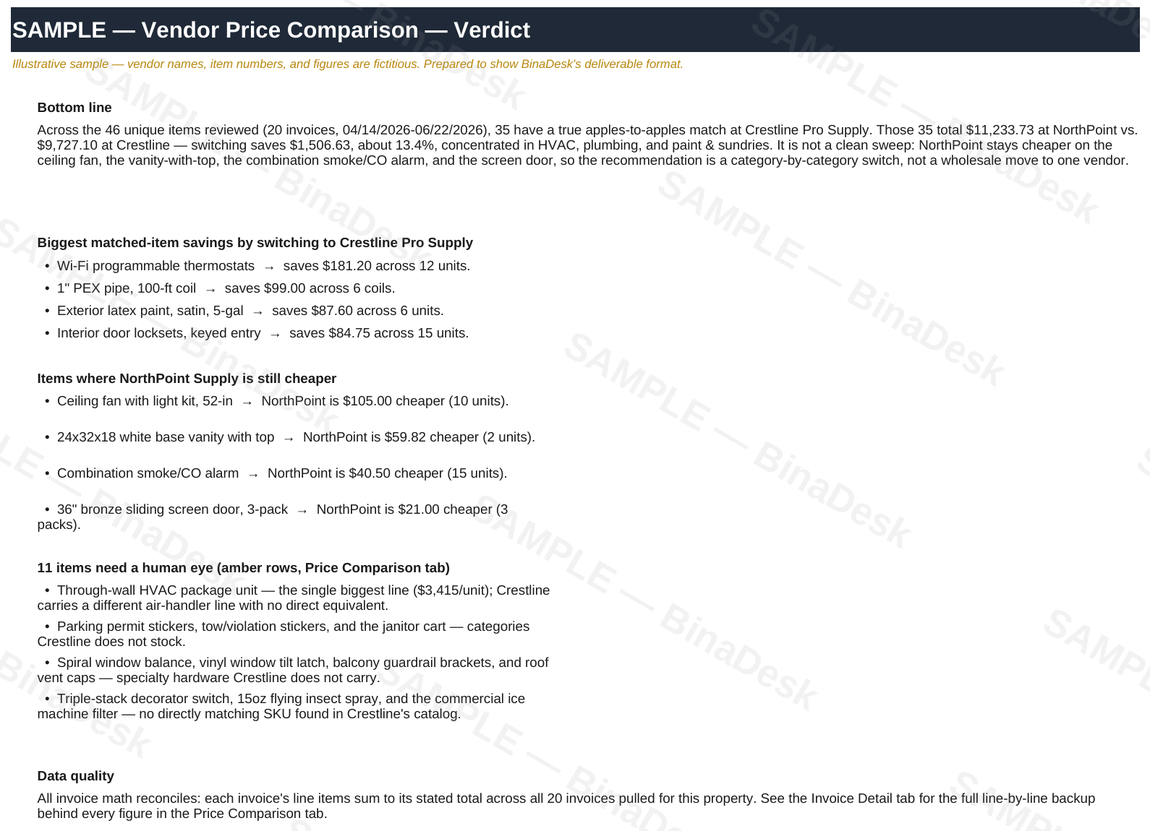
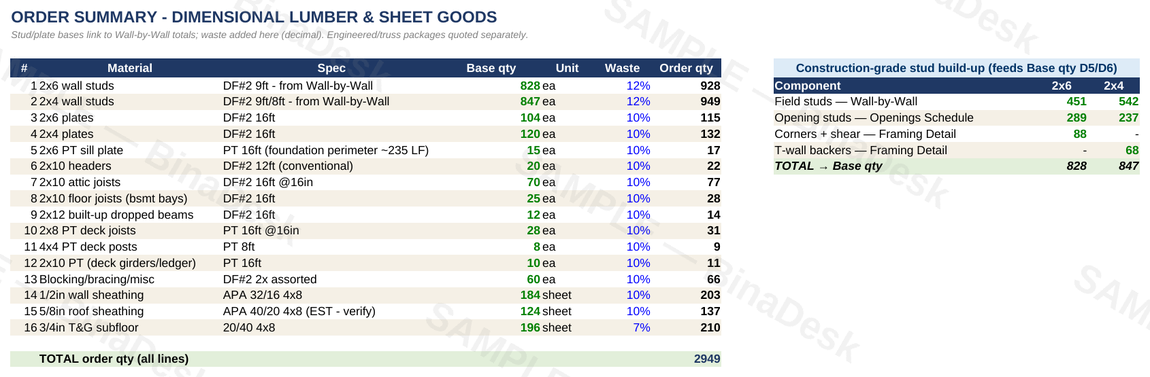
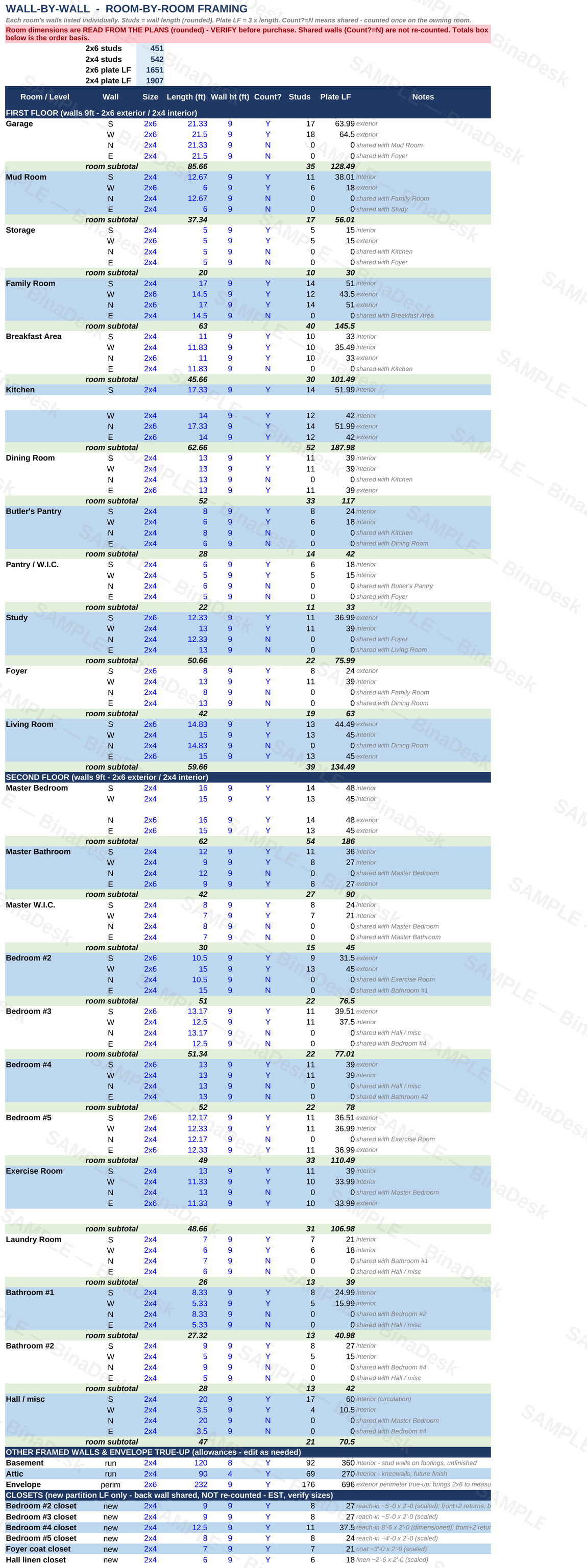
These are watermarked previews. Reach out and we'll send the full sample workbook, or talk through your own project.
We take on work where the answer can be checked against a document you give us. That is the whole rule, and it is what makes every service below verifiable rather than merely fast: a rent roll has the executed leases behind it, a WIP schedule has the job cost and the accounting policy, a takeoff has a plan set, an extraction has the page it came from. Every service runs the same five checks — every figure re-derived a second way, traced back to its source, the workbook recomputed cold by a separate engine, adversarial review, then an analyst on every flag. Anything that cannot be settled from your own documents reaches you marked in place rather than guessed at. The list below is where we work today, not a ceiling. If your task has a source we can check the answer against, tell us about it.
Each service below shows exactly what we need from you, what we do with it, and what you get back.
We build clean spreadsheets to help you evaluate business or real estate deals. Advanced systems handle the complex formulas; we verify the logic is sound before you present to partners or lenders.
Multi-year profit projections, cash flow sheets, risk calculators.
Deal numbers, purchase price, expected income and expenses.
A clean, fully formatted Excel file built to the standard banks and investors expect, with every figure recalculated and traced to the numbers you sent — so your review is a read-through, not an audit.
Months or years of banking history organized into a clear budget. We process thousands of transaction lines and manually audit the trends so every figure is accurate.
Income/expense sorting, spending trend identification, automated budget recommendations.
PDF bank statements or raw CSV transaction exports.
A scannable cash flow report showing exactly where your money is going — every transaction categorised and tagged with the statement file and period it came from, with per-category subtotals. We can also build a trailing-twelve operating statement from the same data — from bank statements where that is all you have, or from a profit and loss where you do — normalised, with every adjustment stated and traceable back to the line it came from.
Upload your invoices from any supplier. We pull current pricing on the same line items from the comparison vendors you specify. Where a vendor requires an account to see your pricing, we share our screen on a call and hand you remote control so you log in yourself, on our screen, and your credentials never pass through us. A line-by-line comparison across hundreds of SKUs that would take a full day or more of manual work comes back to you fast. We deliver a clear side-by-side report showing where you're overpaying and by how much.
Line-item invoice extraction, live vendor price lookup, savings summary report.
Your supplier invoices (PDF or photo), and the comparison vendors you want checked. We never ask for your login credentials. Where a vendor requires an account to show your pricing, you log in yourself during a screen share — nothing is typed or stored by us.
A side-by-side Excel comparison showing current prices from each vendor and your potential savings per item.
Every key lease term pulled into a structured table with a page and clause citation on every field — verifiable by construction, because a term either appears at that citation or it does not. Where you also send the rent roll, we reconcile the two: current rent recomputed from the lease's own escalation schedule stepped forward to today, expirations recomputed from commencement plus term plus exercised options, and concessions checked for presence on both sides. Amendments are ordered by execution date, because getting that backwards produces confident wrong answers.
Commencement and expiration, base rent and escalation schedule, CAM and NNN treatment, percentage rent, security deposit, renewal and purchase options, assignment, subletting and co-tenancy clauses; rent roll variance report where the roll is supplied.
Executed leases and all amendments. The rent roll as well, if you want the reconciliation.
An abstract table with a citation on every field, and where applicable a variance report naming each disagreement between the roll and the leases — escalations that don't match the clause, terms already expired, concessions missing from the roll. Feeds directly into an acquisition model if you want one built.
We process thousands of pages from massive, disorganized files and structure the data precisely. A human reviews the output against the source document before delivery.
Line item extraction from thick packages, invoice organization, receipt sorting.
Unorganized PDFs, scans, receipts, or photos of business paperwork.
A fully organized Excel spreadsheet with every number sortable and searchable.
The work-in-progress schedule is the most consequential spreadsheet a contractor produces. It drives the financial statements, the bonding capacity and the bank covenant, and it is rebuilt every quarter from job data that changes weekly. We build it from your job cost, your change order log, your project managers’ estimates and your own revenue recognition policy — and every figure in it is a formula you can trace back to the input that produced it.
Percentage of completion on a cost-to-cost basis; revenue and gross profit earned; over and under billings reported separately; backlog; loss contracts recognised in full; uninstalled materials excluded from progress; unposted cost accrued and removed from the estimate; stale estimates identified; change orders included on the date they were executed, not submitted; and a covenant summary. Prior-period comparison and movement flags where a prior schedule exists.
Job master, change order log, job cost detail, billing history, your project managers’ estimates to complete, and your revenue recognition policy. Where there is no written policy we work to the standard treatment and tell you every judgment we made.
A live workbook — change an estimate and the schedule, the covenant summary and the checks all recalculate. Plus an exceptions page listing every judgment, every policy departure and every open question, with the clause behind each. Where preparing it surfaces an error in a schedule you have already issued, we quantify it and tell you before this one goes out.
Reading blueprints by hand takes hours. We process complex construction plans rapidly using advanced vision tools, and a human checks the measurements against the plan set for completeness and accuracy.
Material counts, framing measurements, itemized takeoffs from project plans.
CAD or Revit files if you have them (DWG, DXF, RVT) for the most precise takeoffs. PDF blueprints or scanned project plans also work.
A clean Excel checklist of materials and dimensions ready for ordering or bidding.
You already built it with AI. This tells you whether it is right. Send us the output and the documents it was worked from, and we run the same checks we run on our own work: every figure traced back to the page it came from, every total recomputed independently of the formula that produced it, every calculated cell confirmed to be a formula rather than a pasted number, and the arithmetic tested against whatever standard governs the document.
A findings report naming every figure that does not appear in your source documents, every total that does not foot, every cell that holds a typed constant where a formula belongs, and every internal relationship that fails. Each finding cites the location and, where a policy or contract governs it, the clause. You can have the errors corrected as well as reported.
The file the AI produced, and the source documents it worked from. The source documents are what make this worth doing. Without them we can only check that the file agrees with itself — and a file that agrees with itself is exactly what a wrong one looks like.
The findings report, and the log of every check that ran with what each one examined. Where we corrected rather than only reported, you also get the corrected file with each change marked and its reason stated.
Not a separate service — it is four of the services above run as one chain. The leases are abstracted, the rent roll is reconciled against them, the trailing twelve is normalised, and all three feed the underwriting model. Because it runs as one job rather than four, a rent escalation on page 31 of a lease is traceable through to the revenue line it produces in the model.
Lease abstraction with a clause citation on every term · rent roll reconciled to the executed leases · trailing twelve normalised with every adjustment stated · full underwriting model with monthly cash flow, debt schedule, refinance, exit and sensitivities.
The executed leases and amendments, the rent roll, and the trailing twelve operating statement — or, if you don’t have one, the bank statements or the profit and loss, and we will build the T-12 from those. Plus the offering memorandum or purchase agreement and your assumptions on financing and hold period.
Run separately, each piece would be checked against its own sources and no further. Run as a chain, every figure the model rests on is traced back through the reconciliation to the clause or statement line it came from — so an escalation misread on page 31 is caught before it becomes a revenue assumption. Pricing is on the .
Have something that isn't listed above? If the answer can be checked against a document you can send us, we can take it on — any industry, any format. Submit your files and scope, or just describe the task, and we'll return a fixed-rate quote promptly.
Flat-rate quotes based on project scope. No hourly billing, no hidden fees. You see the price before you pay anything.
One-off projects fall into one of three tiers based on volume and complexity. Anything outside these — large pipelines, custom builds — gets its own quote. Recurring work is priced differently; see below. You'll always see the number before you pay anything.
A single bank statement or a short PDF extraction, a quick spreadsheet fix, a one-page memo.
A standard cash flow model, a blueprint takeoff, a stack of invoices or receipts to organize.
Detailed real estate models with monthly projections, multi-account transaction history, large document extractions, multi-property portfolios.
Large pipelines, custom builds, or anything outside the above, we'll scope it and send a number.
Priced as a package rather than four separate jobs, because it is one piece of work. The leases feed the rent roll, and the rent roll and the normalised T-12 feed the model. A rent escalation on page 31 of a lease is traceable through to the revenue line it produces.
Lease abstraction, rent roll reconciliation, normalised T-12, and the full underwriting model.
Executed leases and amendments, the rent roll, and the trailing twelve — or, if you don’t have one, the bank statements or the profit and loss and we build it. Plus the offering memorandum and your financing and hold assumptions.
Because it is one job. Every figure the model rests on is traced back through the reconciliation to the clause or statement line it came from, which is only possible when the four pieces run together.
WIP schedules, lease abstraction and bank statement work are not one-off jobs — they recur for as long as the project or the vendor relationship lasts. Pricing those by file volume makes no sense, so we price them by the unit of work you actually count, on a monthly engagement with a set volume included and overflow quoted before we start it. Tell us your monthly volume and we'll send a number.
Priced per lease abstracted, with rent roll reconciliation quoted alongside it for the same document set.
Priced per statement-month per account, so a year of history across three accounts is a predictable number.
Priced per contract on the schedule, quarterly. Most contractors run the same jobs quarter to quarter, so the number is stable.
Submit your project now and hear back within hours.
Email us your files with a short description. We review the scope, send you a fixed price, and get to work as soon as you approve it. No calls. No surprises.
Send the documents we check against, not just the ones we read. A WIP schedule needs your job cost, change order log and estimates to complete; a rent roll reconciliation needs the executed leases. Without the second set we can read your file but we cannot verify it, and we'll come back and ask rather than deliver something unchecked.
Click to upload or drag files here
PDF, XLSX, CSV, DOCX, images, CAD · 18 MB per file, 24 MB total
Have a question before submitting a project, or need to speak with our team directly? Reach out using the information below.
| Monday – Thursday | 9:00 AM – 5:00 PM |
| Friday | 9:00 AM – 1:00 PM |
| Saturday | Closed |
| Sunday | Closed |
Skip the back-and-forth, submit your project directly and we'll follow up with a flat-rate quote.
No. That's the point of BinaDesk. You don't need to know which AI tool to use, how to prompt it, or how to check its work, that's our job. You describe what you need in plain language, and we handle everything else: running the right tools, reviewing the output, and delivering a finished result you can use immediately. If you've ever felt overwhelmed trying to figure out AI on your own, or simply don't have the time to learn it, BinaDesk exists so you don't have to.
Yes. Not every client comes to us skeptical of AI or unsure how to use it, plenty simply don't have the hours or the headcount to get the work done in-house. BinaDesk works the same way either way: you describe the task, we deliver a finished, human-reviewed result on a flat-rate quote and a fast turnaround. Whether the reason is trust, time, or team size, the outcome is the same, one less thing on your desk.
An analyst resolves it, and in almost every case that is the end of it. They open the original page, read the figure themselves, correct it if needed, and the file continues. That is the normal path and it is why the checks are worth running — a stopped row is caught work, not a problem passed on to you.
Occasionally something genuinely cannot be settled from the documents we were given — a figure that is unreadable on the scan itself, or an invoice with no matching purchase order anywhere in what was sent. Rather than guess, we mark that row in the deliverable with its source page and the reason, or come back and ask you for the missing document. It is a short, specific list when it happens at all, never a file handed over for you to audit.
For anything we verify by comparison, we need the document that holds the right answer as well as the one making the claim. A WIP schedule needs your job cost detail, change order log, estimates to complete and your revenue recognition policy. A rent roll reconciliation needs the executed leases and amendments. A vendor price comparison needs your supplier invoices and the vendors you want checked.
If you send only one side, we will come back and ask for the other rather than deliver something we could not actually check. For extraction and modeling work, your own source documents are the authority and nothing else is needed.
Your files are seen only by the analyst working on your project. We do not share, sell, or reuse client data for any purpose. Files submitted through our platform are used exclusively to complete your requested work and are not retained beyond project delivery unless you specifically request otherwise. For vendor comparison projects, we never ask for or hold your login credentials. We share our screen with you on a call (Zoom, Teams, or your preference) and hand you remote control so you can log into your own supplier accounts yourself, right on our screen. Nothing is typed or stored by us. We're happy to sign an NDA before any files change hands, just mention it in your project notes and we'll send one over. If you work in a regulated industry or have other specific confidentiality requirements, let us know and we'll accommodate.
We prioritize speed. Most projects are completed and back to you the same day. Simpler work is often done much faster. More complex projects, large extractions, detailed real estate models, take longer but we keep you informed. You'll always get a realistic delivery estimate when we send your quote.
No hourly billing or hidden fees. Whether you have a quick spreadsheet fix or a massive thousand-page extraction, you upload your files and describe your scope on our submission page. Our team reviews the exact requirements and emails you a flat-rate quote. If you accept, you pay a secure invoice via Stripe using any major credit card, bank transfer, Apple Pay, or Google Pay. Work starts immediately upon payment.
We fix it, at no extra charge. If the work doesn't match the scope we agreed on, tell us what's off and we'll revise it against that scope until it does. If you spot an error traceable to our extraction, calculation or modeling, flag it within 14 days and we'll correct it or refund the order in full. Work that goes beyond the agreed scope is a new quote rather than a revision — we'll say so up front instead of quietly absorbing it or billing you afterwards. Our goal is a result you can use with a short, specific list of things to confirm, not four thousand rows you have to re-check line by line.
We use the most advanced AI models available and pick whichever fits the task rather than locking ourselves into one system. You never need to know the details, that's exactly the part we handle for you. What matters is that the checking does not depend on the model: your figures are traced back to your own documents, your workbook is recalculated cold by a real spreadsheet engine, and independent models are sent looking for defects with instructions to assume an error exists. A model reviewing its own work is not a check, so the reviewers are never the same model that produced the output.
Plenty of the time you could, and it would be right. That is the honest answer. We tested it: six AI systems were each given a contractor’s job data and their accounting policy and asked to build the work-in-progress schedule that goes to the bank. Two produced work we would have signed. One invented the data outright. The other three were wrong by six figures.
The problem is not the failure rate. It is that you cannot tell which one you got. The wrong schedules were formatted correctly, cited the right policy clauses, and showed their working. Nothing on the page separated them from the right ones. Run the same file twice and you may not get the same answer.
What we sell is not a lower error rate. It is that when something is wrong you find out — because the arithmetic has to close, every figure has to tie to a document you gave us, and you get the log of what was checked. And it runs the same way every month whether or not anyone remembers to look.
Yes, and this is the service where we are most explicit about what checking can and cannot do. Dimensions are read from the plan set and material quantities are derived from them, then cross-checked: room dimensions must sum to the building footprint, stud counts must track the wall linear footage they came from, and the perimeter must close. Those catch a great deal.
What they cannot do is prove a dimension was read correctly when the only source is the drawing itself. Reading it twice does not help if both reads share the same error. So takeoffs come back with the quantities that reconcile marked as reconciled, and anything resting on a single unverifiable read marked as needing your eye before you order material. That is a more useful deliverable than a confident number, and it is the honest one.
Traditional providers bill manual, repetitive data entry by the hour, and usually want a large minimum volume and a long onboarding before they will start. We handle extraction and structural setup with automated pipelines, so our analysts spend their time on the rows that actually need judgment. That means no minimums, same-day turnaround on most work, and a flat rate you see before you commit. We are not trying to be the cheapest option on the market — offshore data-entry shops will always undercut us on price. We are trying to be the one where you can see what was checked.
If the work doesn’t match the scope we agreed, tell us what’s off and we revise it against that scope until it does, at no charge. If you find an error traceable to our extraction, calculation or modelling, flag it within 14 days and we correct it or refund the order in full — your choice, not ours.
Work that goes beyond the scope we quoted is a new quote rather than a revision. We say so up front instead of quietly absorbing it or billing you afterwards.
Refunds go back to the original payment method and usually appear within 5 to 10 business days. The full terms are on the .
Usually, and there is one test that decides it: can the answer be checked against a document you can send us? An invoice against a purchase order, a figure against the page it came from, a rent against the clause that sets it, a total against its own line items. Any industry, any format.
That works because our checking has two layers. Eleven structural checks run on every job we deliver regardless of what it is — every figure appears in a source document, every total recomputes from its parts, every calculated cell is a formula and not a pasted number, and a check that examined too few rows fails the file rather than passing it. On top of those sit checks written for your particular work, taken from the policy, contract or standard that governs it.
So describe what is on your desk. If it has a source we can check the answer against, we will tell you how we would handle it and what it costs. If it doesn’t, we will tell you that too rather than take the work.
"Bina" refers to understanding or applied intelligence, the ability to take raw information and turn it into something usable, accurate, and complete.
Reach out directly or submit your project and we'll handle the rest.
Every deliverable is checked against your own source documents and signed off by a person before it reaches you. If something still is not right, here is exactly what happens.
If a delivered file contains an error traceable to our extraction, calculation or modeling, we correct it at no charge. If you would rather not continue, we refund the order in full. Report it within 14 days of delivery.
Cancel any time before work begins for a full refund. If production has already started, we refund the portion not yet completed.
If your documents turn out to need substantially more work than the quote covered, we contact you before going further. You can approve a revised quote or cancel for a full refund. We do not do extra work and bill you for it afterwards.
Please contact us first at info@binadesk.com. We reply within one business day and would far rather resolve it directly than through your card issuer.
Refunds are issued to the original payment method and typically appear within 5–10 business days, depending on your bank.
We'd rather answer them up front than have you find out afterwards.